• About
  • Contact Us
  • Frequently Asked Questions
  • Meet the Team
  • What our readers think
  • Subscriptions
  • CWA on Twitter
  • CWA on Facebook

World Archaeology

Digs, Discoveries, Travel, Exploration


  • Features
  • Issues
  • Blog
  • Great Discoveries
  • Travel
  • World Heritage
  • Sites by region
    • Most popular
      • Italy
      • Greece
      • Egypt
      • Turkey
      • France
    • Africa
    • Asia
    • Australasia
    • Europe
    • South America
    • North America
  • Subscriptions
This is from CWA > Issue 10 > Features > Jordan > Petra, Jordan

Petra, Jordan

March 7, 2005 by Schmid, Dr S Filed Under: Issue 10, Features, Jordan

Petra is one of the mystery cities of the ancient world. Everywhere there are tomb facades quarried into the rose-red hillsides. But how did these tombs function? The best answer appears to come from the Tomb of the Roman Soldier – which is not Roman at all, so here it is called the Tomb of the Soldier. This is one of the best preserved tombs, but one of the least visited, as it lies far from the main tourist route. Currently Stephan Schmid is excavating it on behalf of the Palestine Exploration Fund and others, and here he asks the big question: how did these tombs actually ‘work’?

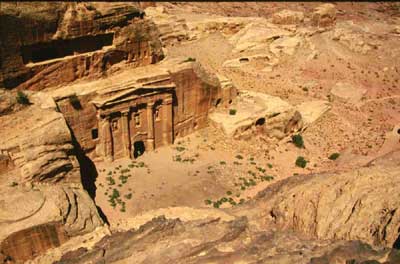
The Tomb of the Soldier not in the main valley at Petra, but is set across a narrow side valley. Here the tomb itself is top right, the facade carved out of the red sand stone. It faces across a courtyard to another room on the far side (see below) where ritual banquets were held . In the foreground is the elaborate entrance which blocked up the width of the valley to form the courtyard beyond.

Facing the tomb was the dining room or triclinium, hollowed out of the living rock. The low benches on which the diners reclined can be seen round the sides.

The entrance to the tomb on the up hill side was marked by another elaborate facade known as the ‘Garden Temple’. Note to the right the stone wall which is one end of a huge cistern which supplied water to the whole complex.


This article is an extract from the full article published in World Archaeology Issue 10. Click here to subscribe


You might also be interested in...
Petra Discovered
Petra Discovered
Jordan
Jordan
Lot’s Monastery, Jordan
Jordan from the Air
Jordan from the Air
Beatrice de Cardi
Beatrice de Cardi
prev next
FacebookFollow UsSubscribeE-Newsletter

Subscribe Now
* Save ££s on the cover price
* Never miss an issue
* Delivered to your door

Subscribe / Renew from:
UK | USA | Rest of World

Click for a Gift Subscription

welcome to world archaeology

Welcome to Current World Archaeology, the magazine that studies archaeology round the world.

CWA was founded in 2003 as a sister magazine to Current Archaeology which, since 1967, has been reporting on the latest discoveries in British archaeology.

But CWA does not just look at the latest discoveries: it also travels the globe, looking at great monuments around the world, explaining how they came to be the sites - and sights - we see today.

Caitlin McCall, Editor

Map

7 Wonders…

The Oseberg ship as it looks today

7 ship-shape sites

We’re in a maritime mood today. Read on for seven of our favourite ship-related archaeological sites. Bon Voyage!

CARTER PORTRAIT

7 facts you might not know about Howard Carter

Today (May 9) is Howard Carter’s birthday, so we thought we would share some of our favourite facts about the discoverer of Tutankhamun’s tomb.

Queen Yaba's Tiara

7 Fashionable Finds

Throughout history people have been keen to keep up with the latest trends and fashions. These seven finds shine a light on our long history of sartorial innovation.

Great Discoveries

875

Mohenjo-daro

Mohenjo-daro represents an entire Early Bronze Age civilization on a par with those of contemporary Egypt and Mesopotamia.

961

Rosetta Stone

How did a slab of black granite become the key to deciphering hieroglyphs

1012

Palatine Hill

The remains – remarkably unprepossessing amid the spectacular ruins of classical Rome all around – comprise postholes, wall-slots, and drainage gullies, defining three small structures.

898

Vindolanda Tablets

In Spring 1973, Robin Birley made the greatest discovery of his life: a small, thin fragment of wood which unfolded to reveal ink-marks…

710

Linear B Tablets

When Arthur Evans started digging at Knossos on Crete in 1900, a major aim was to find inscriptions and prove that the ancient Cretans had been literate.

Tags

1st Milennium AD Basic Books British Museum Press Bronze Age Chrysalis Classical Early Modern featured Medieval Neolithic Palaeolithic

Recent Posts

  • New photos of Vinkovci’s Roman vessels
  • 7 Fashionable Finds
  • Not the end of the world, predicts newly found Maya calendar
  • Ancient language discovered
  • 7 facts you might not know about Howard Carter

Quick Links

  • About
  • Contact Us
  • Frequently Asked Questions
  • Meet the Team
  • Subscriptions
  • What our readers think

Current World Archaeology is copyright © 2012 Current Publishing Ltd | Terms & Conditions | Purchasing & Returns