• About
  • Contact Us
  • Frequently Asked Questions
  • Meet the Team
  • What our readers think
  • Subscriptions
  • CWA on Twitter
  • CWA on Facebook

World Archaeology

Digs, Discoveries, Travel, Exploration


  • Features
  • Issues
  • Blog
  • Great Discoveries
  • Travel
  • World Heritage
  • Sites by region
    • Most popular
      • Italy
      • Greece
      • Egypt
      • Turkey
      • France
    • Africa
    • Asia
    • Australasia
    • Europe
    • South America
    • North America
  • Subscriptions
This is from CWA > Issue 33 > News > Turkey > First written reference to Soul

First written reference to Soul

January 6, 2009 by Chris Catling Filed Under: Issue 33, News, Turkey

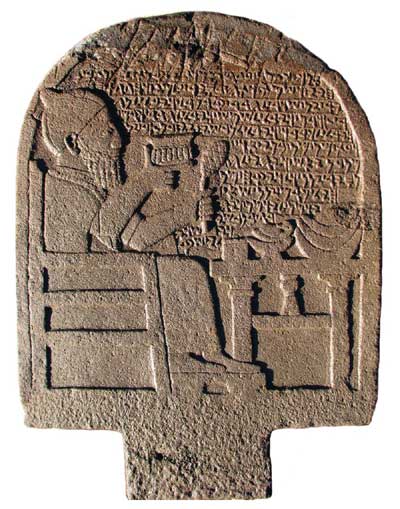
Archaeologists in South Eastern Turkey have discovered an Iron Age stone slab that provides the first written evidence in the region that people believed in a soul that was separate from the body. The 8th century BC stele, carved from basalt, was excavated intact in its original location by a team led by David Schloen, Director of the University of Chicago’s Neubauer Expedition to Zincirli, the site of the ancient city of Sam’al, once the capital of a prosperous Iron Age kingdom.
The inscription reads in part: ‘I, Kuttamuwa, servant of Panamuwa, am the one who oversaw the production of this stele for myself while still living. I placed it in an eternal chamber and established a feast at this chamber: a bull for [the storm-god] Hadad … a ram for [the sun-god] Shamash … and a ram for my soul that is in this stele.’
The stele was set against a stone wall in the corner of the small room that had been converted into a mortuary shrine for the royal official Kuttamuwa, who is depicted as a bearded figure wearing a tasselled cap and fringed cloak, raising a cup of wine in his right hand. He is seated on a chair in front of a table laden with food, symbolising the eternal banquet he no doubt hoped to enjoy. Beside him the inscription enjoins his descendants to bring food for his soul – and, indeed, remains of food offerings and fragments of polished stone bowls of the type depicted in Kuttamuwa’s banquet were found in front of the stele.
The significance of the stele lies in its evidence for the meeting of Semitic and Indo-European cultural traditions in a kingdom contemporary with ancient Israel located in the border zone between Anatolia and Syria. Kuttamuwa and his king, Panamuwa, have non-Semitic names, reflecting the migration of Indo-European speakers into the region centuries earlier under the Hittite Empire. Kuttumuwa’s inscription shows a belief in the enduring human soul which inhabited his stone monument, possibly because the remains of the deceased were cremated. By contrast, cremation was abhorrent in traditional Semitic thought, because the body and soul of the deceased were considered to be inextricably linked. •


This article is an extract from the full article published in World Archaeology Issue 33. Click here to subscribe

FacebookFollow UsSubscribeE-Newsletter

Subscribe Now
* Save ££s on the cover price
* Never miss an issue
* Delivered to your door

Subscribe / Renew from:
UK | USA | Rest of World

Click for a Gift Subscription

welcome to world archaeology

Welcome to Current World Archaeology, the magazine that studies archaeology round the world.

CWA was founded in 2003 as a sister magazine to Current Archaeology which, since 1967, has been reporting on the latest discoveries in British archaeology.

But CWA does not just look at the latest discoveries: it also travels the globe, looking at great monuments around the world, explaining how they came to be the sites - and sights - we see today.

Caitlin McCall, Editor

Map

7 Wonders…

The Rosetta Stone

7 revolutionary writings

We often think of archaeology as being all about objects, but written sources are just as fundamental to our understanding of the past.

Queen Yaba's Tiara

7 Fashionable Finds

Throughout history people have been keen to keep up with the latest trends and fashions. These seven finds shine a light on our long history of sartorial innovation.

Part of the -controversially- reconstructed palace at Knossos

7 discoveries that changed the archaeological world

7 game-changing finds that captured the archaeological imagination.

Great Discoveries

Great Discoveries

Gustafson at Oseberg

Gustafson’s excavation had provided an extraordinary window into the material culture and public appearance of the world represented by the Norse Sagas at the beginning of the Viking Age.

Great-Zimbabwe-2

Great Zimbabwe

The ruins of Great Zimbabwe extend over 720 hectares of rocky hill and valley in south-central Zimbabwe. Yet it’s origins were often denied…

Radiocarbon Revolution

Radiocarbon Revolution

How radiocarbon dating revolutionised our concept of social evolution.

Great Excavations

Troy: Great Excavations

Heinrich Schliemann has been described as ‘the creator of prehistoric Greek archaeology’, but he was an amateur when he took up archaeology aged 46 after making his fortune in business.

1030

Abbeville stone tools

The Abbeville tools – in context – proved the antiquity of human beings

Tags

1st Milennium AD Basic Books British Museum Press Bronze Age Chrysalis Classical Early Modern featured Medieval Neolithic Palaeolithic

Recent Posts

  • New photos of Vinkovci’s Roman vessels
  • 7 Fashionable Finds
  • Not the end of the world, predicts newly found Maya calendar
  • Ancient language discovered
  • 7 facts you might not know about Howard Carter

Quick Links

  • About
  • Contact Us
  • Frequently Asked Questions
  • Meet the Team
  • Subscriptions
  • What our readers think

Current World Archaeology is copyright © 2012 Current Publishing Ltd | Terms & Conditions | Purchasing & Returns